Hackathon URJC
We started as five people on the leadership team, trying to convince a single company to sponsor a student event nobody had heard of yet. Three editions later, we were directing more than 70 people, and Hackathon URJC had become Madrid's largest university entrepreneurship competition.
48 hours where student teams focus on building a working prototype, guided the whole way by mentors, CEOs, CTOs and other industry professionals. Across those three editions we've worked with more than 40 companies and handed out more than €15,000 in prizes.
The challenge was not simply to organise a weekend of building. It was to create enough clarity and trust for a large volunteer team, major technology partners and first-time participants to move toward the same experience.
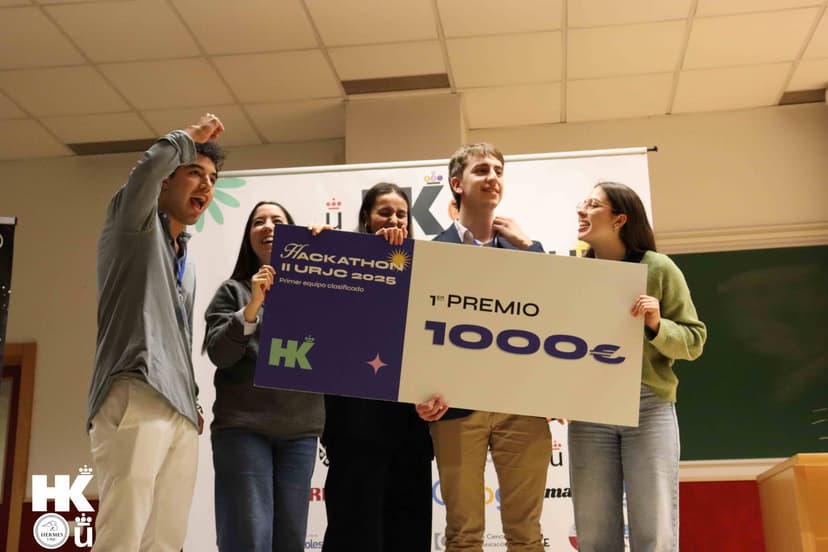
Across editions, more than 550 people registered, approximately 400 attended and over 40 sponsors supported the project. Behind those figures was a five-month cycle of decisions, conversations and coordination.
The gap
At Universidad Rey Juan Carlos, there was no shortage of technical curiosity — just nowhere to test it against a real company's problem. Companies wanted access to that talent.
What we wanted was to close that gap: to get hundreds of students to trust us, and to trust themselves, for one weekend. That trust was the real product we built in year one. The event came after.
One sentence
Turning that trust into something real meant one thing above all: a 48-hour competition simple enough that a first-year student and a company CEO could both explain it in one sentence. That meant a leadership team able to pull it off, sponsors willing to put up a real challenge and real money, a schedule tight enough for two days, and communication clear enough that nobody had to ask twice what came next.
From briefings and value propositions to prototypes — and not just presentations, talks, classes — everything passed through the hands of a group of people who weren't special. They just wanted to build something better for everyone else.
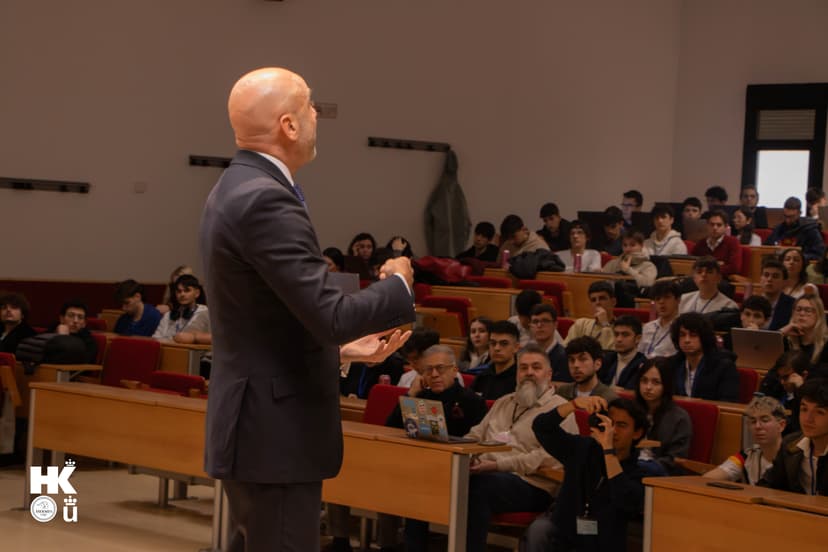
Where I fit
The first meeting, we were three people. The last one, more than 30. Laura in the Netherlands2, Mario in Germany, and me in my room having no idea what I actually wanted yet — in the good way. I ran strategy, communications and product design from the first week.
Here, communication was never separate from strategy — deciding what we told a sponsor was usually the same decision as deciding what we were building.
By the third edition my department had grown tenfold, inside a wider team of more than 70, and the job had quietly turned into something else.
Five months
The five months follow roughly the same shape every year: lock the story, build the team, sign the first sponsor — every sponsor after that one gets easier — open registrations, brief the challenges, then spend the last few weeks turning a spreadsheet into a weekend that actually works.
Inside the team we ran our own classes, teaching each other tools that felt professional for someone who's just started their degree, or hasn't even started yet.Figma1, Meta Suite, automations, business design, pitching — you teach me, I teach you.
Who showed up
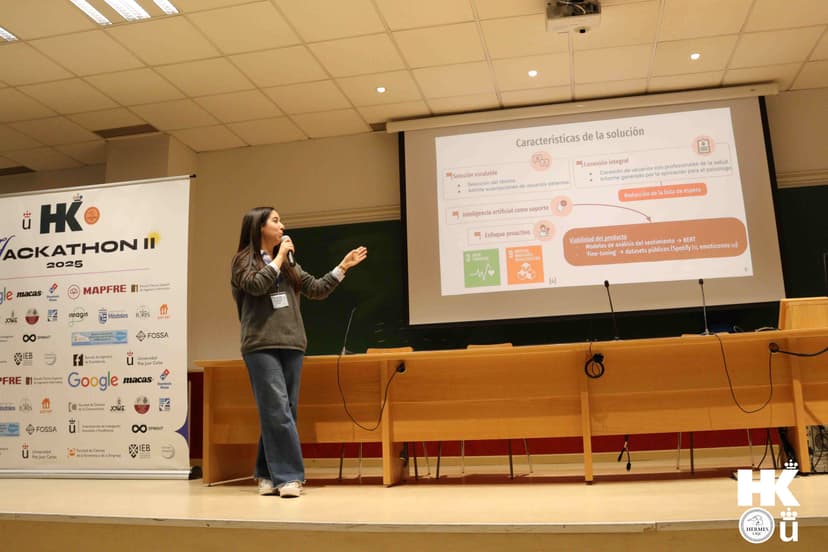
Across three editions, we've worked with more than 40 companies and handed out more than €15,000 in prizes. Among them: Microsoft, Google, DHL, Mapfre, JetBrains, Imagin, Starknet — and many more.
The pitch to a new sponsor was never really about the logo. It was: here's a problem you actually have, come see what a team of strangers does with it in 48 hours.
One rule
The rule I kept coming back to: every message should make the next action obvious. An announcement explains why it matters. An internal update says what changed. A handoff has a name attached — not a role, a name.
It sounds obvious written down. Getting seventy people to actually do it, across three editions, was most of the job.
What it adds up to
The numbers I actually trust are the ones that repeat: companies that came back for a second challenge, mentors who asked to be invited again, a leadership team that went from five people to directing more than 70 without anyone being told to recruit.
What stuck
Product design isn't a layer you add once the plan's already locked. For a team this size, it is the plan.
I learned to lead by making context visible instead of chasing status updates — and that four hundred people don't get served well by one person having a great weekend. They get served by seventy people3 who know what good looks like and don't wait for permission to act.
What I take from this: I like what I do. And that in this country, there are people who aren't just going to lead one day — there are people who are going to be happy doing what they do.
Footnotes
- We tried a shared Canva board first. It survives one person; hand it to thirty and everyone's dragging the same layer at once.↩
- Coordinating a hackathon across three time zones from one group chat is, itself, a small hackathon.↩
- Seventy is also, roughly, how many unread chats I had by the third edition.↩